
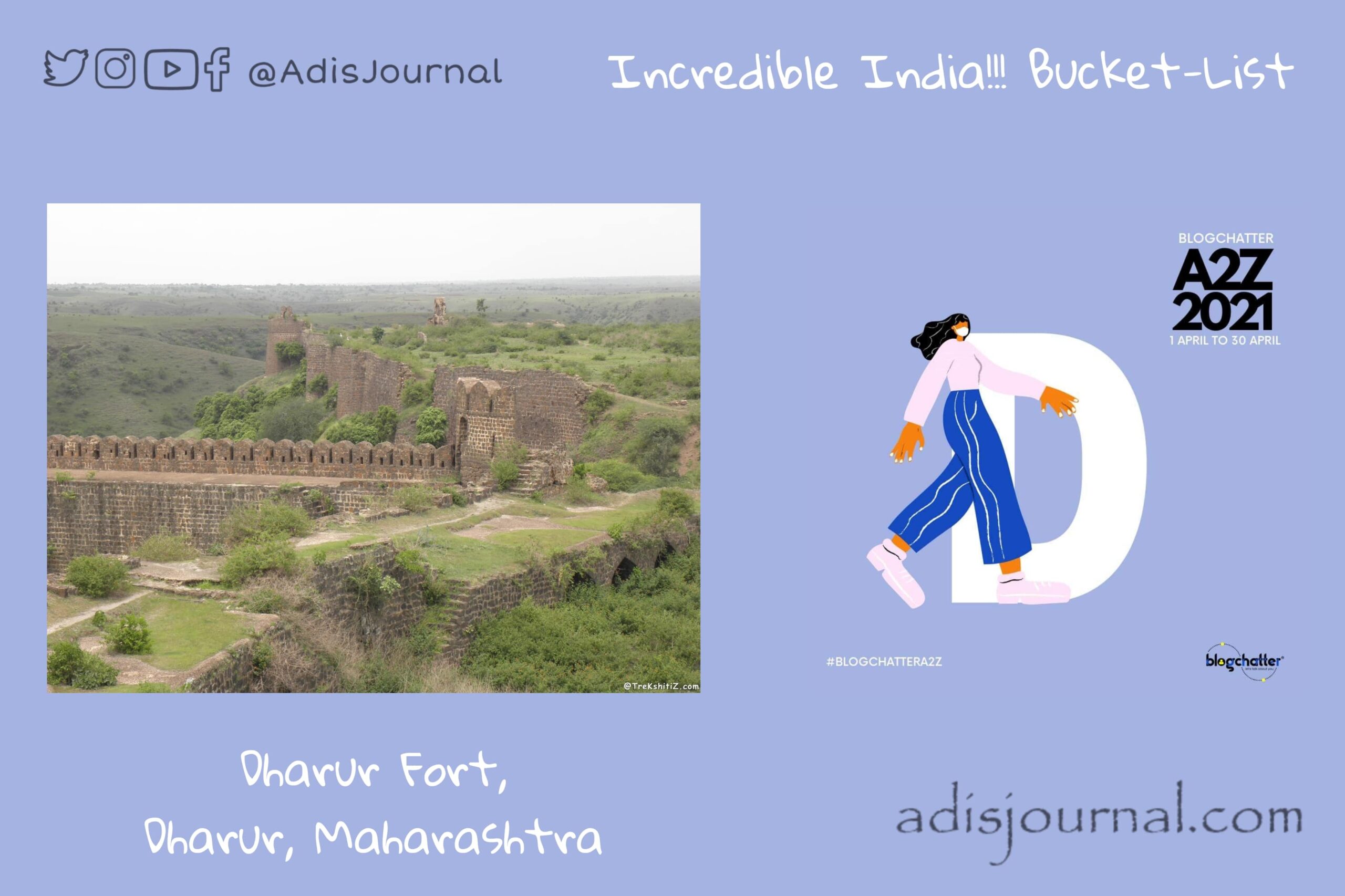

It’s a second leg of our Incredible India!!! bucket-list journey after first Sunday break. Today we are visiting a historic place which stands witness to a very large part of our history. We are visiting an old fort of Dharur (धारूर) which is in Latur district of the state of Maharashtra. This is a gem from a comparatively unexplored area of Marathwada.
I would like to mention a very amazing treasure trove of information about forts in Maharashtra at the very beginning of this post, TreKshitiZ. You will find very nicely documented, indexed information on their site. I don’t remember when I stumbled upon this site for the first time, but I have been using it at least for a decade now whenever I need any information about Maharashtrian forts. Credit for the photos which you will see in this post goes to them.
Story time:
Back in the days of Satvahanas, Dharur rose to become an important market town on a major road to Satvahana capital city, Paithan. The Rashtrakuta dynasty followed the Satvahanas and ruled the region. Understanding the vitality of Dharur as a market town, they built a fort called “Mahadurg” for its protection. They just piled stones on top of eachother and built battlements and walls.
Subsequently, Kalyani Chalukyas, Devgiri Yadavas and Bahmani Sultanate ruled the region. After the fallout of the Bahmani Sultanate in five different factions, this particular region came under the influence of Barid Shah of Bidar. This region witnessed frequent battle action during the volatile period that followed after that. Baridshahi of Bidar succumbed to this volatility, and Adilshah gained control over Dharur.
Kishwarkhan from Adilshah court constructed a new fort at the same place of the Mahadurg using stones of the old one in 1567 CE. This is the fort which still stands the ground. Just a couple of years after that, Nizamshah took charge of the place in 1569 CE and in 1630-31, Mughals took control of Dharur.
Later it fell in the hands of Nizams of Hyderabad and remained in their control except a brief period of Maratha rule till the accession of Hyderabad principality to the union of India.

What not to miss:
Dharur Fort has a straight access from Dharur town as both of them are at the same level. However, the fort has a natural protection of the valley from the remaining three sides. This is a very unique combination in itself. 4.2 m wide and 4.5 m deep mote secures the side with straight access.
There are two walls protecting the fort with battlements at regular intervals to mount the defances. One of the battlements houses the mint started by Mughals. As a memorial to the capture of Dharur fort, they issued a coin. This mint produced Mughal coins for almost the next hundred years. There are two major water tanks with the names of Godi Dindi (गोडी दिंडी) and “Khari/Solapur Dindi” (खारी/सोलापूर दिंडी). There is a dysfunctional “Hamam” with decorative water faucets. We can see a few guard rooms, a couple of mosques, a temple and ruins of various palaces in this fort. Fort also houses a few Percian inscriptions scattered around
Fort was inhabited till the Indian Independence. As a result of this, it’s in a pretty decent condition. Marathwada region is not famous for tourism but this fort is a gem from this unexplored region. You can stay in the town of Ambejogai or Parali Vaijanath. Both of these are important pilgrimage sites of Hinduism and have good accommodation facilities. Please plan to visit this place and share the word about this.


Photo courtasy: TreKshitiZ
Adisjournal or me personally don’t have any claims of copyright over the photos you see in the post. I am a fan and frequent user of a wonderful trekshitiz.com to which these images belong.
I am participating in the A2Z challenge with Blogchatter and this is my take on day 4 challenge. “D is for the Dharur Fort, Latur District”. You can find my other posts from this challenge here.








 Hey guys, last two days you didn’t see me introducing any more author to you. I took these two days to recollect what entire month has offered me as a blogger, writer and most importantly as a bibliophile, a reader. It would not be a lie if I tell you that many of the authors I introduced you through my series ‘Kathaka’, were unknown names for me before I chose this theme. However, this entire month widened my eyes made me read about these 26 fabulous storytellers. Their lives, their style of writing, the time and place they lived in or living in. It was a wonderful journey to know a bit about all of these men and women. I am really looking forward to starting reading the books I mentioned. I wish for this TBR A to Z will become Book Review A to Z for 2019 challenge.

 Today, we are at the last stop of our A to Z journey of this 2018 challenge. I would like to introduce you all to Zakaria Tamer, who is a Syrian short story writer. Tamer, born on 2nd January 1931, is one of the most important and widely read and translated short story writer from Arab literary world. Tamer, also known as ‘little pea Ziad’ has been writing short stories since late 50’s and since then he has published eleven short story collections, two collections of satirical articles and several children’s books. Tamer is considered as an influential master of the Arabic-language short story. Tamer continued to teach himself with a voracious reading as he had to quit the school to support the family at the age of thirteen. He became interested in politics and was encouraged by contact with intellectuals to continue his education at night school. With this background, representing the very poor majority of men and women in Syria, with their joyless and restricted existence in his writing became his literary intention.
 The book I would like to read and include in this TBR list is one of the two collections which got translated into English. Breaking Knees: Sixty-three Very Short Stories from Syria. As the title suggests, this book as sixty-three very short stories like flash fiction, which comment about corrupt, fearful lives under a violent dictatorship, it is possible to discern echoes of the storm that has brought Syria to near-disintegration. The stories in the book are Wry, satirical and bawdy, and are always informed by his dark view of humanity and of Syrian society in particular. Considering the current situation Syria, this book seems to be the amazing chance to have a sneak peek in Syrian society.