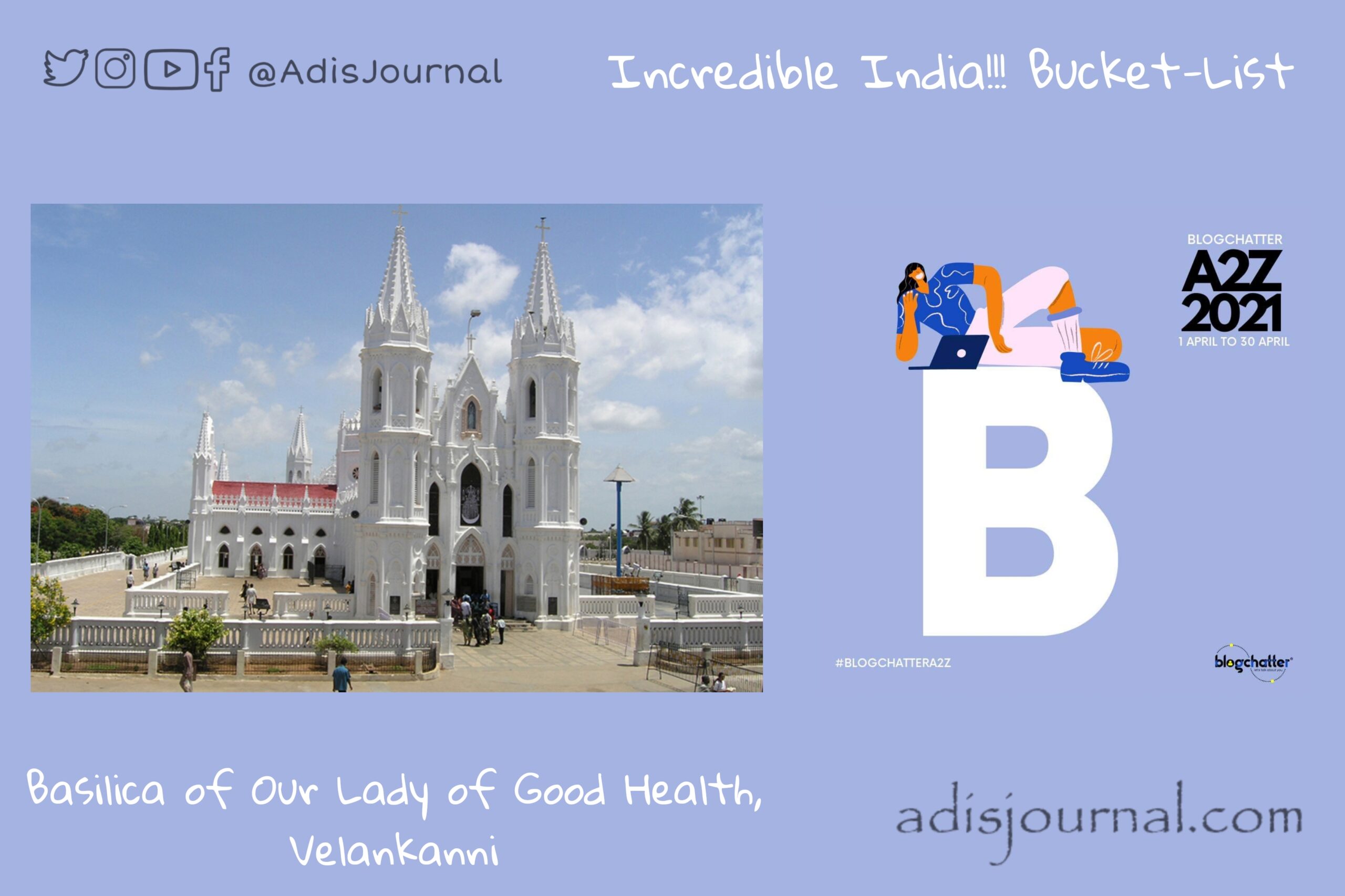
This bucket-list journey started with the magnificent Chola legacy of Airavatesvara Temple, Darasuram. Our today’s destination is not far away from it. Merely 80-85 km towards east of Darasuram, there’s a small village of Velankanni. This coastal village is the house of our today’s “Incredible India Attraction”. The Basilica of Our Lady of Good Health is a Marian Shrine on the coast of Velankanni. Built in the Gothic style of architecture, this shrine is a major pilgrimage for Christians in India.
Story Time:

This Basilica is dedicated to Our Lady of Good Health and is attributed to three miracles attached to the area around it. Oral tradition of the stories of two apparitions of the Virgin Mary and the saving of Portuguese Sailors from the storm in Bay of Bengal are the only source of these miracles as there are no historical written records about them.
First apparition of the Virgin Mary dates back to the mid 16th century. Local shepherd boy was on his milk delivery duty. A woman holding a child asked milk for the little one to a shepherd boy. Boy moved to his next delivery after giving some milk to the woman. When he completed the delivery, he discovered the milk jug was still full with fresh cool milk. Then, a small shrine was built at the place of apparition called Matha Kulam, which means Our Lady’s Pool.
Second time, Virgin Mary appeared in front of a crippled buttermilk seller boy asking buttermilk for the little one in her hand. Answering her request, the boy gave some buttermilk. Woman then asked him to go to the next town and meet a gentleman there. After reaching there, ask the gentleman to build a chapel in her honour at that location. As soon as he started the journey, he realized that he is no longer a cripple. They quickly built a thatched chapel in the honour of Our Lady of Good Health (Arokia Matha in Tamil).
Third miracle occurred to the Portugues Ship sailing from Macau to Sri Lanka. The ship got caught in a horrific storm in the Bay of Bengal. When sailors prayed to Virgin Mery under her title “Star of the Sea” storm subsided. As a result, all 150 sailors reached the coast and as a thanksgiving rebuilt the shrine to Our Lady of Good Health and continued enhancing it in their subsequent voyages.

Gothic Architecture of Basilica Photo by Krrishnah Copyrights CC BY-SA 4.0 
Right side of Main Chirch Photo by BrownyCat Copyrights CC BY 3.0 
New extension to the Basilica Photo by BrownyCat Copyrights CC BY 3.0 
Matha Kulam (Our lady’s pool) Photo by Muzirian Copyrights CC BY-DA 4.0
Architecture:
This Basilica is a classic example of a place rising to glory with time. Started with just a thatched chapel, Basilica is currently standing in its glory of Gothic Architecture. Currently, the Shrine Basilica contains three chapels, as well as Our Lady’s Tank, Church Museum, Priests’ Residence, Offering Center, Stations of the Cross, Stations of the Rosary, Shrine Mega Mahal and Vailankanni Beach. This magnificent white Gothic building has red-tiled roofing. It witnessed many extensions like one one southern side in 1928 and the northern side in 1933. Latest extension included a new two storied church with 28 m high dome and 25 m Gothic spirals to accommodate multilingual pilgrims. This extension took place in 1974-75.
Significance and Pilgrimage:
HH Pope John XXIII granted the status of Minor Basilica to this shrine on 3rd November 1962. through an Apostolic Brief. He also aggregated it to the Basilica of St. Mary Major in Rome.
Annual festival takes place between 29 August to 6 September. This is the time along with Christmas Velankanni Basilica draws maximum pilgrims. As a result, “the Lourdes of the East” is a suitable title for this place. Annual festival has many rituals like mass, novenas, flag-hoisting and carrying a ‘palkhi’ of Mary in a procession. Procession is the major event. Only women are allowed to pull the first car while the statue of Mery is in the last car of the procession. The car of the Mery is the most decorated one in the procession. People of other religions also take part in this procession. Many pilgrims shave their heads and perform ear-piercing. Both of these are Hindu traditions. Hence, this is a very significant site of pilgrimage displaying the meeting point of two major religions of the world – Christian and Hindu.
At this point, the day 2 of our journey comes to the halt. Let’s just enjoy this white Gothic architecture and have a good night rest. Tomorrow is one more exciting day of this journey.
I am participating in A2Z challenge with Blogchatter and this is my take on day 2 challenge. “B is for the Basilica of Our Lady of Good Health, Velankanni”. You can find my other posts from this challenge here.


Hey guys, last two days you didn’t see me introducing any more author to you. I took these two days to recollect what entire month has offered me as a blogger, writer and most importantly as a bibliophile, a reader. It would not be a lie if I tell you that many of the authors I introduced you through my series ‘Kathaka’, were unknown names for me before I chose this theme. However, this entire month widened my eyes made me read about these 26 fabulous storytellers. Their lives, their style of writing, the time and place they lived in or living in. It was a wonderful journey to know a bit about all of these men and women. I am really looking forward to starting reading the books I mentioned. I wish for this TBR A to Z will become Book Review A to Z for 2019 challenge.

Today, we are at the last stop of our A to Z journey of this 2018 challenge. I would like to introduce you all to Zakaria Tamer, who is a Syrian short story writer. Tamer, born on 2nd January 1931, is one of the most important and widely read and translated short story writer from Arab literary world. Tamer, also known as ‘little pea Ziad’ has been writing short stories since late 50’s and since then he has published eleven short story collections, two collections of satirical articles and several children’s books. Tamer is considered as an influential master of the Arabic-language short story. Tamer continued to teach himself with a voracious reading as he had to quit the school to support the family at the age of thirteen. He became interested in politics and was encouraged by contact with intellectuals to continue his education at night school. With this background, representing the very poor majority of men and women in Syria, with their joyless and restricted existence in his writing became his literary intention.
The book I would like to read and include in this TBR list is one of the two collections which got translated into English. Breaking Knees: Sixty-three Very Short Stories from Syria. As the title suggests, this book as sixty-three very short stories like flash fiction, which comment about corrupt, fearful lives under a violent dictatorship, it is possible to discern echoes of the storm that has brought Syria to near-disintegration. The stories in the book are Wry, satirical and bawdy, and are always informed by his dark view of humanity and of Syrian society in particular. Considering the current situation Syria, this book seems to be the amazing chance to have a sneak peek in Syrian society.

Born in November of 1972, Yiyun Li is a Chinese American writer who writes in English. After completing her graduation from Peking University in 1996, she moved to US and in 2000 earned her MS in immunology from University of Iowa. She took a turn towards creative writing by 2005 after completing her MFA degrees from the same university. Her short stories and essays have been published in The New Yorker, The Paris Review, and Zoetrope: All-Story. A couple of stories from her first story collection ‘A Thousand Years of Good Prayers’ have been adapted by director Wayne Wang in to films.
Her latest story collection Gold boy, Emerald Girl is what I wish to include in my TBR. As the blurb of book says, stories are set in 21st century China where economic development has led to new situations unknown to previous decades: residents in a shabby apartment building witnessing in awe the real estate boom; a local entrepreneur-turned-philanthropist sheltering women in trouble in her mansion; a group of retired women discovering fame late in their lives as private investigators specialising in extramarital affairs; a young woman setting up a blog to publicise the alleged affair of her father.

Xue Yiwei, A Chinese – Canadian storyteller born and brought up in Hunan Province of China. But after his graduation in Computer Science at Beijing University, he studied English literature in Université de Montréal. He has authored 16 books including four novels and five story collections. These books have received him a great appreciation from Chinese people. This wide readership had taken his short story collections and essays in critics’ Top 10 lists in Asia. He moved to Montréal as a safe heaven to write his heart’s content as he couldn’t do the same after getting turned down by publishers for his novel Dr. Bethune’s Children because the attitude of the novel’s expatriate narrator was judged as harmful to China’s reputation. Though this was not the first case as he was walking the thin line between unfettered self-expression and maintaining a readership in China since 1989 when he started his literary career.
The book I am putting up on this TBR list is a short story collection titled Shenzheners. This is translated into English by Darryl Sterk is about people from Shenzhen city. Shenzhen is the young city in Hong Cong which got declared as Special Economic Zone in 1980 as an experiment to introduce capitalism to Communist China. A city in which everyone is a newcomer, Shenzhen has grown astronomically to become a major metropolitan centre. Hailed as a Chinese Dubliners, the original collection was named one of the Most Influential Chinese Books of the Year in 2013, with most of the stories appearing in Best Chinese Stories.