Author: Adi Sathe

  • Life is beautiful with a seasoning of salt – Book Review

    Life is beautiful with a seasoning of salt – Book Review

    Every day we witness so many instances which are part of a story unfolding around us. It is really a difficult thing to pick those instances up and look at them as a third person and narrate a story. Storytelling is indeed a difficult task. You have to know how to build it up to give one of a kind experience to reader or listener of your story. After reading this book, I can safely and happily say Asfiya Rahman has a knack to keep you engaged in her stories.

    Life With a Pinch of Salt is her latest collection published in Blogchatter’s Ebook Carnival. I am thankful for them to put it in reader’s hands. Stories included in this very short collection are woven around tiny instances of everyday life which we all experience. This relatability made me finish this tiny collection in one sitting.

    Things which I enjoyed

    First of all, I can’t stop myself from praising the gorgeous cover design with simple salt and paper shakers. Life is really bland without seasoning of fun, quirk and bizarre. Asfiya has story for everything above and some extra. Even though stories are very short flash fictions, they are complete in itself. I am eagerly waiting for more stories from her. Hope she bring out more and more such books!

    Blurb

    Life is a wonderful gift that each one of us has been given. We often get bogged down by the mundane routine of life and the weight of our expectations and forget this. This collection of short stories and flash fiction is a small attempt to remind us that life is messy and adventurous and full of surprises.

    Life isn’t meant to be perfect, it’s meant to be lived.

    About the book

    Title: Life With a Pinch of Salt
    Author: Asfiya Rahman
    Pages: 38

    My review

    Story: 4/5
    Cover Design: 4.5/5

    Overall rating: 4.25/5

    You can grab your copy of Life With a Pinch of Saltby Asfiya Rahman here.

    Should you read it?

    I enjoyed this little book and I hope it has picked me up from my reading slump. I hope this will pick you up from yours too if you are having one.


    This is a part of Blogchatter’s Ebook Carnival. If you want more book recommendations, click here.
  • Dharma Artha Kama Moksha – Poetry by Seethalakshmi Suraj

    Dharma Artha Kama Moksha – Poetry by Seethalakshmi Suraj

    My journey in the world of poetry began quite late. I hardly enjoyed them during my school days. However, when I was in college, something came to me spontaneously and my journey started. My lines were not polished, nor they had a particular form. So I started to read about poetry. After a decade or so, I can dare to say that I write a decent poetry in Marathi with one audiobook under my belt. “चिमुकली स्वप्ने” my first and only poetry collection is available on storytel for you all to enjoy.

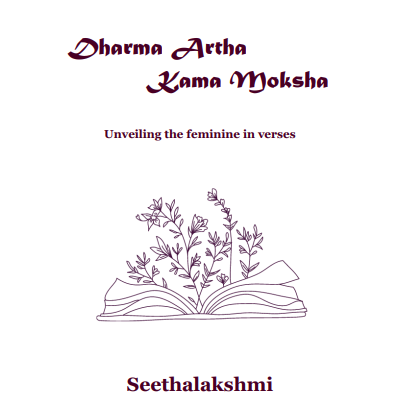
    However, my understanding of English poetry is that of a beginner’s level. I sometime fail to comprehend if a particular piece is a poetry or just a paragraph. I found Seethalakshmi’s “Dharma Artha Kama Moksha” in Blogchatter’s E-book librabry. This particular book is a part of their Ebook carnival where I have also put up my book ओंजळभर प्रेम.

    Who did I like this one?

    Let me tell you very frankly that I fail to understand quite a few poems in this book due to my lack of understanding. Yet there are few pieces which grabbed my attention and one of them is “I See a Monster from My Window”. I just loved the way she has created this imagery of continuously growing plastic eating monster which one day will eat us all. My most favorite lines from the poem are

    Who feeds the monster, you ask?
    Oh, to remember every name, is a task
    It’s definitely me, it’s definitely you,
    It’s our every neighbour, old & new

    I see a monster from my window | Harita (Dharma Artha Kama Moksha by Seethalakshmi)

    She has penned poems covering four aspects of human life and I am sure every poet atleast once have written about Moksh / Mukti in one form or the other. Even I couldn’t stop myself from writing

    लागे मज आस, सायुज्य मुक्तीची,
    तोड बेडी आता, कर्मचक्र… ||

    I liked the way she has designed the book. Yet only think which is missing in the copy of ebook is the cover used in other graphics. Use of the same cover would have improved the appearance a bit. I am enjoying my this learning experience and am sure people who are ahead of me on this path will enjoy this collection for sure.

    You can grab your copy of Dharma Artha Kama Moksha by Seethalakshmi here.


    This is a part of Blogchatter’s Ebook Carnival. You can read more of my book recommendations here.

  • One when you miss the bus – Review of The Demons of Jaitraya

    One when you miss the bus – Review of The Demons of Jaitraya

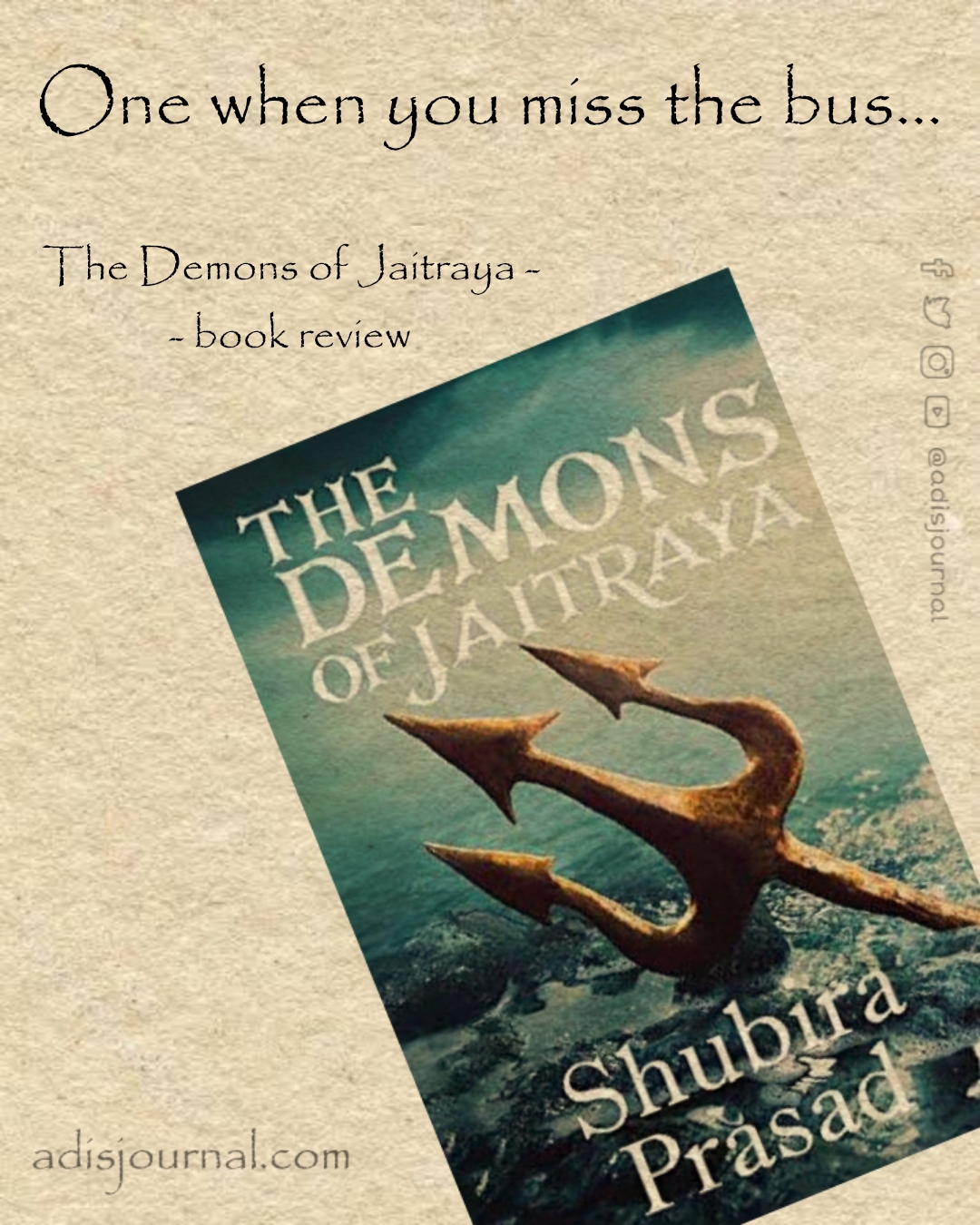
    Indian mythologies have such a strong characters and folklore surrounding it, that any fiction author will get enticed to work on them. Some try to retell the story from different character’s perspective or some try to take the characters to entirely different era and see what will happen to them. Shubira tried the second thing.

    Review

    Plus point of The Demons of Jaitraya is a very strong plot to work with. However, I find the book an okay read for one time read. Her book couldn’t keep my eyes glued to words she has written. But i would not attribute this to her writing or storytelling. I think this book could have been more crisp and enticing with a better editing. There was a lot of repetition. Some things were told again and again which almost felt like copy paste of earlier paragraphs. I hope other books of this series have taken care of this. Cause I don’t want to lose out on this wonderful plot of events happening when Demons escaped from past wreaking havoc in today’s time and age.

    Blurb

    The epics say, in the great War of Ramayana, a number of rakshasas escaped. They hid in the bowels of the Earth, in the water and in space and remained dormant for eons. In the 20th century of the Christian era, however, some of them reappeared in different forms to plague the Earth with Wars and illnesses. At the end of his war with Ravana, Rama had asked Hanuman to raise and train a contingent of warriors who would take birth multiple times on Earth, to contain the demons. Aishani and adheesh are two such warriors, blessed with divine weapons and powers to fight the world’s evils at present times. Read this exciting story to know who finally wins. The good or the evil? The demons of jaitraya is the first book of the trilogy of the war between demons and humans.

    About the book

    Title: The Demons of Jaitraya
    Author: Shubira Prasad
    Publisher: Vitasta Publishing Pvt Ltd
    Pages: 242

    Where to Buy

    My review

    Story: 3/5
    Editing: 1/5
    Writing style: 3/5
    Cover Design: 2/5

    Overall rating: 2.25/5

    Should you read it?

    Personally, I think book has missed the mark and is ok to read once if you are into mythological fictions. Overall, strong story, poor editing, ok cover. Pick up at your own risk.


    If you want more book recommendations, click here.

  • “D” bole to – Digitization – First step towards modern maps

    “D” bole to – Digitization – First step towards modern maps

    Today, we all rely on gadgets and apps to help us through our day-to-day activities. From keeping our appointments to ordering food, we use hundreds of mobile applications and computer softwares. Widespread internet connectivity on the go has revolutionized the way we live in the twenty-first century. This digital revolution came into cartography (science and art of mapmaking) too and mapmaking saw a change by leaps and bounds. This transformation started with the basic activity of digitization.

    What does digitization mean?

    New digital platforms and softwares were designed to map maps. But to build this virtual world of online maps, the real world needed to be converted into digital form from old paper forms. This process of bringing old maps into the digital environment is called digitization. Digitization helped mapmakers to bring all the old efforts of their forefathers into the new environment. It helped to keep the body of knowledge relevant even in this new digital era.

    How to digitize?

    There are two types of digitization of the old paper world. One is to just scan it and store it online to put on the display. Other one needs more work and concentration. Do you remember using tracing papers to trace your favourite artwork or pattern to replicate it? This type of digitization is nothing but the digital tracing. Here, user imports the scanned map / image in a map making software and then traces the various elements meticulously to capture all the details. 

    When I was studying geoinformatics during my Masters degree, one lab course was about digitization. One of the very tedious task of digitizing a toposheet. It was taxing on the eyes, especially when we were digitizing contours (lines which join the same elevation of the ground) on toposheets. Pune region is especially hilly and undulating putting those contours very close to each other and we often used to start digitizing one contour and unknowingly jump to adjacent contours in between. But all in all, it was a fun exercise, if your file doesn’t corrupt during the process.

    It’s fun, when you become “pro”

    After my masters, I got a chance to see cities all over the world. I saw Melbourne and Sydney in Australia,Paris, London and Lisbon in Europe, New York and Los Angeles in the USA. No no, I didn’t travel to all these cities. I was working in a company where our team digitized building footprints from various aerial photographs of these cities. Our group of 5-6 guys working in the second shift was famous for getting any complex image processed in record times. We used to get the images to process where others would have failed. I enjoyed this task for some time and left that company for better and challenging opportunities.

    Census 2011 map of Mawal Taluka, Pune
    Digitized Mawal taluka boundaries by CDSA, Pune

    However, digitization remains one of the basic tasks of any mapmaking project which has some connection with the historical data. (Which happens almost every time). In the online interactive map shown above I have digitized some of the institution buildings in Pune and around them have created a buffer of silence zone as per the noise pollution control rules. While the static map below shows the village locations, boundaries of Mawal Taluka of Pune District digitized from census 2011 maps.

    So, hope you enjoy the hard work done by some of us in the form of navigation systems of your cars or phones. (Bas google navigation ki galti ki galiya hame mat dijiye…)


    I’m participating in #BlogchatterA2Z. You can read my other posts about maps and map-reading here.

  • Cadastral maps: backbone of land revenue system

    Cadastral maps: backbone of land revenue system

    Today, let’s build the first thing on our canvas of base-map. I think most of you might have seen something or the other form of this painting I am about to paint for you today. If you happened to be curious about the house you live in, you would have seen the architectural drawings of that particular building. In some corner of that paper inked with blue lines and grainy tint of old ammonia prints, you must have seen a miniature drawing. That’s the cadastral map. Cadastral map is the backbone of any land revenue system in the world. But let first understand what is the cadastre or cadaster in the first place.

    Cadastre! What is the big fuss about it?

    Land has been the prized possession of any rural since ancient times. It was the way to measure the greatness of the kind or the kingdom. However, there was one more important angle to getting more and more land under one’s control. It was also the source that filled the coffers of the kingdom. Taxes levied on people were always in connection with their landholdings. Earlier, it used to be in the form of the produce they grow on that land. Later it took the form of the currency. To calculate the amount to be taxed, one must know how much land that person owns. This led to the generation of land records.

    English word “Cadastre” has its roots in Greek language. It came in English via French language. Greek word katástikhon means a list or a register.

    Back in the glorious days of the Roman Empire, they created a record of state owned lands. Cadastral maps of Campania were done in 77 AD. William the conqueror has created a record book of the land which he won and annexed to his kingdom. In France, Napoleon has created the land record systems. In the Middle East, During the 18th century, land records used to get written on terracotta plates. One such plate is on display in the Ancient Orient Museum, Istanbul.

    In Indian context, Chatrapati Shivaji Maharaj created his own land records system called Rayatwari and a new tax system where his people could pay the taxes in currency or produce both. In Mughal Courts, during the decline of their power, land records and revenue collection was given to the East India Company and a new era of Indian Land Records began which continues even today.

    A cadastre text written on a terracotta tablet. From the 18th century BC in Sippar, Iraq, and held by the Ancient Orient Museum, Istanbul. Photo by Osama Shukir Muhammed Amin, Copyright CC BY-SA 4.0

    Cadastral Maps: important and fascinating document

    Earlier days, the cadastral records were maintained in words describing boundaries of the property. Later, these details have been combined with a map. And thus, the cadastral maps started. Typically, a cadastral map shows the layout of various plots of the land labelled with survey numbers or plot numbers and the total area of plots. Some times, these maps also contain other features like land use, reservations and zoning. But that story is for some other time.

    Now land record departments across the globe are digitizing the cadastral maps and integrate them into Geographic Information System (GIS) or Land Management System (LMS). About these new events, we will talk in our next chapter. These new systems store all the information about the plot in particular cadastre, like owner details, area, use, builtup area if any, tax status, etc. Every cadastral parcel get these attributes attached to it. Users of these systems can access this information easily with simple searches or mouse clicks on digital cadastral maps.

    Sample Cadastral Map. Image Copyright Intergovernmental Committee on Surveying and Mapping, Austrelia

    In rural areas of Maharashtra, tehsildar or talathi holds these maps and records while in urban centres of the country, City Survey Departments house cadastral maps. In other parts of India similar authorities have the responsibility of preparing, amending and publishing the cadastral maps. So, tell me in the comment section if you have seen these maps somewhere? And if you haven’t seen the cadastral map of the plot of your house, go and get your copy from these offices. 


    I’m participating in #BlogchatterA2Z. You can read my other posts about maps and map-reading here.

  • Base-map: canvas for a map-maker

    Base-map: canvas for a map-maker

    Do you remember your school days, when your geography teacher would ask you to get some blank outlines of either a map of India or the state about which you are studying that year? It used to be just a blank canvas. Simple plain white paper with outline printed mostly in blue colour. Then the teacher would ask you to mark either some tourist spots, or mineral mines or something of that sort on that map. To tell you the truth, I used to dread those times. Every dot I used to put on that blank paper, my anxiety would pile up. Fear of making the wrong map is real. Sometimes even today, it creeps back into my mind. But, about that, some other time. Let’s know more about this canvas of us map-makers; base-map.

    Base-map: a chance to start a fresh

    However, my interest in maps increased as time passed and I decided to be a map-maker. When I was studying map-making, that dreadful thing in my school days got introduced to me as a “base-map” on which a map-maker builds his or her version of the world. It always acts as a blank canvas to start a new story. Sometimes, it may be about the way to travel from one place to the other. While some stories may tell you about what particular region eats as their staple food. You can tell any story with this blank canvas.

    India Administrative Outline: Copyright – Maps of India
    Maharashtra District Outline: Copyright – d-maps

    Nowadays, with the advancement of technology, even maps have gone digital. These days, we make maps on online platforms. It gives us a chance to play with our canvas. Why have only plain white canvas to work with? You can add colour, texture and funk to your story right from the base maps. Let me show some funky designs I made to use as a base map. I am still the story to tell on that design.

    Don’t let the labels, roads and colours on this map fool you. This is just the base-map. It doesn’t tell any story as it is. It just shows a core part of Pune City in India. But if I start adding data on a particular theme or subject on this, say old temples in the city, or schools or hospitals, then it will be a meaningful map. When you open a map on your phone, it shows a map with a bunch of landmarks on it. Unless you search something in particular, or start the navigation function, technically it’s just a base-map. Depending on the purpose of the map, a base-map can be anything from a blank outline to a funky, colourful map with some data-points on it.

    Would you like to tell a story on this canvas? Let me know in the comment section below.


    I’m participating in #BlogchatterA2Z. You can read my other posts about maps and map-reading here.